
Thursday, 23 June 2011

Thursday, 3 March 2011
RESEARCH FOR POSTER
- Is the movie title prominently featured? Is the text easy to read?
- Are the main actors shown? If so, which ones?
- What is the design of the movie poster? Does it accurately reflect the mood and tone of the film?
- What other images are included? What do you notice about the framing of the images?
- What text is shown on the poster? Is there a catchy slogan? If so, what does it tell you about the movie's story?
- Is there any other important information included on the poster?
- Why do/don't you think this movie poster is persuasive
ON GOLDEN POND:
1- the movie title is prominently featured and easy to read
2- In the poster are shown four actors, three of them they are famous: Henry Fonda, Jane Fonda and Kathrine Hepbourne.
3- The poster design is very classic, the backgrounds in brown and the mains actor are drawn
4- There are no other images, the framing looks old and in a classic style.
5- The title, mains actors (the name of jane fonda put in bold) two slogan, one that tell us that the movie it is been achieved three academy oscars and the other one is a slogan from the daily news magazine about how touching the movie is.
6- No i don't think there are any other important informations
7- I think the movie poster is persuasive because it's classic, there are no much action or violence in that.
it's just the draw of the mains actors looking towards the lake maybe.

MOVIE THAT I DIDN'T LIKE THE POSTER
THE FUGITIVE:
1- The movie title is prominently featured and easy to read
2- In the poster it is just shown the first main actor (harrison ford) and not the other main actor(Tommy Lee Jones)
3- In the poster you can actually see Harrison Ford run close to a train.
The baground is black with huge white titles.
4- There are no other images edited
5- There are three important slogan.
the first one that the people can see at the first glance is HARRISON FORD IS THE FUGITIVE, Then up on the left side we got a slogan that tells you a bit of the plot.
The third one is at the bottom of the poster and it says the date of the release in the cinemas.
6- Another important information is the label of the Warner Bros company at the bottom of the poster.
7- I like this movie a lot but I don't like the poster because the picture dosen't tell you about the film much.
In this poster the movie looks more like an action movie while it's a thriller movie.
The other actor Tommy Lee Jones very important as Harrison Ford it is cut off from the poster.

Thursday, 17 February 2011
PHOTO IN STUDIO


We used three types of lights, Back Light, Head Light and Fill LIght.
We also used a white paper screen, we used cannon eos camera with 400ios 5.6F.
The Lights were also on a flash mode so we could get the best that we can of our pictures!
Thursday, 10 February 2011
CAMERA OBSCURA EXPERIENCE
HOW TO MAKE A CAMERA OBSCURA

- First thing to do is empty a Pringles can, then draw a line at the bottom and cut along the line
- Make a tiny hole at the shorter bottom piece of the can
- We are going to use the plastic lid as a screen, put the plastic lid on the shorter piece of the can and attach the bottom part with the top part with saletape.
- To keep the light out we need cover the entire can with alluminum paper.


- Now go outside on a sunny day and look through the Pringles can, to get a clear image you may need to cover with your hand the opening tube. You are going to see an upside- down coloured picture.
- The hole doesn't make the picture, the image of the world was always there.The small just make you see it.
Thursday, 3 February 2011
MUYBRIDGE'S MOTION


That is an example how Muybridge create the motion picture.
We used four cameras in a row, we set all the cameras in the same mode, same high, same speed and same position.
a person walked by and we took 5-6 shoot for each step.
next step is going to be put all the shots together and so create a motion picture.
Thursday, 20 January 2011
THE DAGUERROTYPE
https://docs.google.com/viewer?a=v&pid=explorer&chrome=true&srcid=0B4PdEr8dnpOjNjMyZWRkNzgtZjBhZi00Y2E4LWFjOTItZWRlYTk4MWM5ODA0&hl=en
1- Can you find image evidence of the tecnique?
2-when was it the first discovered and by whom?
3-how does this tecnique work?can you find and describe the processes needed to make it work? maybe illustrate how it is made?
4-what it is special about tecnique?
5-can you comment how important this tecnique has been for the history of photography. for example was it popular and is it still used today?
CAMERA OBSCURA:
1-
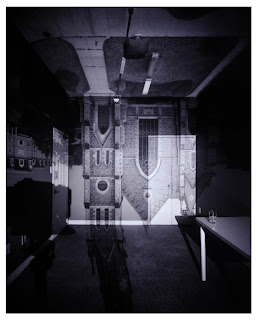
2- The first mention of a camera obscura was in 390BCE by Mo-Ti but was a greek philosopher Aristotle who understood the first principles.
he viewed the crescent shape of a partially eclipsed sun projected on the ground through the holes in a sieve, and the gaps between leaves on a plan tree.
3-To set up a camera obscura you need to go into a dark room, make a small hole in window cover and look at the opposite wall.
you are going to find the world upside down outside the window
4- The camera obscura is used for drawing and for in entertaiment and it was one of the invention to led to photography.
5- The camera obscura has been very important because it was the first step that led us to photography.
the last camera obscura it is been installed in 1994 in London, it is still used by professional photographers.
THE DAGUERRETYPE
1-

"L’Atelier de l'artiste. An 1837 daguerreotype by Daguerre, the first to complete the full process"
2- The daguerretype it was developed by Louis Daguerre together with his friend Joseph Nicephore Niepce in 1840
the image of daguerretype is formed by amalgam or alloy of mercury and silver.
1-

5- The colour photography it was and it is very important.
1- Can you find image evidence of the tecnique?
2-when was it the first discovered and by whom?
3-how does this tecnique work?can you find and describe the processes needed to make it work? maybe illustrate how it is made?
4-what it is special about tecnique?
5-can you comment how important this tecnique has been for the history of photography. for example was it popular and is it still used today?
CAMERA OBSCURA:
1-

2- The first mention of a camera obscura was in 390BCE by Mo-Ti but was a greek philosopher Aristotle who understood the first principles.
he viewed the crescent shape of a partially eclipsed sun projected on the ground through the holes in a sieve, and the gaps between leaves on a plan tree.
3-To set up a camera obscura you need to go into a dark room, make a small hole in window cover and look at the opposite wall.
you are going to find the world upside down outside the window
4- The camera obscura is used for drawing and for in entertaiment and it was one of the invention to led to photography.
5- The camera obscura has been very important because it was the first step that led us to photography.
the last camera obscura it is been installed in 1994 in London, it is still used by professional photographers.
THE DAGUERRETYPE
1-

"L’Atelier de l'artiste. An 1837 daguerreotype by Daguerre, the first to complete the full process"
2- The daguerretype it was developed by Louis Daguerre together with his friend Joseph Nicephore Niepce in 1840
the image of daguerretype is formed by amalgam or alloy of mercury and silver.
3- the daguerreotype, along with the Tintype, is a photographic image allowing no direct transfer of the image onto another light-sensitive medium, as opposed to glass plate or paper negatives. Preparation of the plate prior to image exposure resulted in the formation of a layer of photo-sensitive silver halide, and exposure to a scene or image through a lens formed a latent image. The latent image was made visible, or "developed", by placing the exposed plate over a slightly heated (about 30°C / 90°F) cup of mercury. Daguerre was first to discover and publish (in the publication of the process and the English patent of 1839) the principle of latent image development.
The mercury vapour condensed on those places on the plate where the exposure light was most intense (highlights), and less so in darker areas of the image (shadows). This produced a picture in an amalgam, the mercury washing the silver out of the halides, solubilizing and amalgamating it into free silver particles which adhered to the exposed areas of the plate, leaving the unexposed silver halide ready to be removed by the fixing process. This resulted in the final unfixed image, which consisted of light and dark areas of grey amalgam on the plate. The developing box was constructed to allow inspection of the image through a yellow glass window to allow the photographer to determine when to stop development.
The next operation was to "fix" the photographic image permanently on the plate by dipping in a solution of hyposulphite of soda, often called "fixer" or "hypo", to dissolve the unexposed halides. Initially, Daguerre's process was to use a saturated salt solution for this step, but later adopted Hershel's suggestion of Sodium thiosulphate, as did W. H. F. Talbot.
The image produced by this method is extremely fragile and susceptible to damage when handled. Practically all daguerreotypes are protected from accidental damage by a glass-fronted enclosure. It was discovered by experiment that treating the plate with heated gold chloride both tones and strengthens the image, although it remains quite delicate and requires a well-sealed enclosure to protect against touch as well as oxidation of the fine silver deposits forming the blacks in the image. The best-preserved daguerreotypes dating from the 19th century are sealed in robust glass cases evacuated of air and filled with a chemically inert gas, typically nitrogen.
4- light reflects through the daguerrotype and bouncing through the back of it creating a 3D effect, you can only make one image of a daguerrotype.
5- The daguerrotype it is not used today.
COLOUR PHOTOGRAPHY
1-

" The first color photograph made by the three-color method suggested by James Clerk Maxwell in 1855, taken in 1861 by Thomas Sutton. The subject is a colored ribbon, usually but perhaps incorrectly described as a tartan ribbon."
2-Colour Photography was attempt around 1840.
early experiments were directed at finding a "chamaleon substance" wich assume the colour of the light falling on it.
Edmond Becquerel achieved better results but he couldn't find no way to preven the colour to fast fading when the image were exposed to the light.
the three-colour method was suggested 1855 by the scottish physicist James Clerk Maxwell.
it is based on the fact that the human eye sees the colour because its inner surface it is covered with millions of cells.
The first colour photograph made according to Maxwell's prescription, a set of three monochrome "colour separations," was taken by Thomas Sutton in 1861 for use in illustrating a lecture on colour by Maxwell, where it was shown in color by the triple projection method. The reproduction of a red-dyed ribbon and separation between blue and green ribbons were a mystery for decades, as the photographic materials of the time were almost completely insensitive to red light, and barely sensitive to green. Finally, in 1961, Evans showed that many red dyes also reflect ultraviolet light, coincidentally transmitted by Maxwell’s red filter, and surmised that the three images were probably composed of ultra-violet, blue-green, and blue wavelengths, respectively, rather than red, green, and blue.
3- Maxwell found that all the colors of nature could be counterfeited to the eye by mixing only three pure colors of light – red, green and blue – in proportions which would stimulate the three types of cells to the same degrees that the "real" colors did.
4- The special things about the colour photography is that the images seems more real.
5- The colour photography it was and it is very important.
Colour photography was very popular during the II World War, many pictures of war had been taked and the coloured pictures of Adolph Hitler and his empire are now part of our history.
Nowdays the colour photography has been replaced by the Digital Photography but many photographs find the colour photography more artistic and interesting than the digital photography.
Friday, 26 November 2010

Friday, 19 November 2010
EXHIBITION
2.3 Exhibition
Exhibition Day will be Thursday 2nd December
This task is to Print, Frame/mount you pictures in lesson for and exhibition. To plan for this exhibition you will need as a class to think about:
· Where to hold the exhibition
T42
T42
· How it might look
Put my best pictures on a displayboard
Put my best pictures on a displayboard
· Who to invite
Schoomates, friends, anyone who is interesting in photograph
Schoomates, friends, anyone who is interesting in photograph
· Titles for the Photos
-Dracula can sing!
-The War Is Over
-Wating for a cup of coffee
-Watching Telly
-Dracula can sing!
-The War Is Over
-Wating for a cup of coffee
-Watching Telly
· Health and Safety
Be careful not to trip over the displayboard, don't block the front door and put a sign out
Be careful not to trip over the displayboard, don't block the front door and put a sign out
During the exhibition you will need to get feedback on your photos. This feedback will help you when writing your evaluation.
Thursday, 18 November 2010
PHOTOS OF THE LITTLE PEOPLE


Friday, 12 November 2010


Friday, 5 November 2010
TREATMENT
PROGRAMME WORKING TITLE: LITTLE PEOPLE
DIRECTOR/ CARLO SACCENTI
CAMERA OPERATOR: CARLO SACCENTI
DURATION: 0
FORMAT: Photography
AUDIENCE: New students at the College
STORY RESUME: My first photo is going to be with the little man dressed in purple in front of huge TV, I going to take this photo in the college classroom.
In my second picture I would like to use the Dracula's miniature singing close to a microphone.
I had this idea because the first impression that I had looking at this miniature is that he was singing opera.
In my third picture I want to use the miniature dressed in green with a leg hurt and I would like to use other two people, a mother with a small child.
I would like make the scene of this soldier coming back home from the war and meeting his family.
The last picture is of the little old man with walking-stick waiting at the coffee machine for a nice and hot cup of tea.
CHARACTER RESUME:
C2: A young boy dressed with a purple shirt with his hand with his hand resting under his cheek.
A4: A grown up woman dressed with a blue top and a yellow skirt with a small child.
Dracula: simple Dracula miniature
The man with the injured leg
D1: The old man with the walking-stick and dressed in grey
DIRECTOR/ CARLO SACCENTI
CAMERA OPERATOR: CARLO SACCENTI
DURATION: 0
FORMAT: Photography
AUDIENCE: New students at the College
STORY RESUME: My first photo is going to be with the little man dressed in purple in front of huge TV, I going to take this photo in the college classroom.
In my second picture I would like to use the Dracula's miniature singing close to a microphone.
I had this idea because the first impression that I had looking at this miniature is that he was singing opera.
In my third picture I want to use the miniature dressed in green with a leg hurt and I would like to use other two people, a mother with a small child.
I would like make the scene of this soldier coming back home from the war and meeting his family.
The last picture is of the little old man with walking-stick waiting at the coffee machine for a nice and hot cup of tea.
CHARACTER RESUME:
C2: A young boy dressed with a purple shirt with his hand with his hand resting under his cheek.
A4: A grown up woman dressed with a blue top and a yellow skirt with a small child.
Dracula: simple Dracula miniature
The man with the injured leg
D1: The old man with the walking-stick and dressed in grey
MY IDEA
My first photo is going to be with the little man dressed in purple in front of huge TV, I gonna take this photo in the college classroom.
In my second picture I would like to use the Dracula's miniature singing close to a microphone.
I had this idea because the first impression that i had looking at this miniature is that he was singing opera.
In my third picture I want to use the miniature dressed in green with a injured leg and I would like to use other two people, a mother with a small child.
I would like make the scene of this soldier coming back home from the war and meeting his family.
The last picture is of the little old man with walking-stick waiting at the coffee machine for a nice and hot cup of tea.
In my second picture I would like to use the Dracula's miniature singing close to a microphone.
I had this idea because the first impression that i had looking at this miniature is that he was singing opera.
In my third picture I want to use the miniature dressed in green with a injured leg and I would like to use other two people, a mother with a small child.
I would like make the scene of this soldier coming back home from the war and meeting his family.
The last picture is of the little old man with walking-stick waiting at the coffee machine for a nice and hot cup of tea.
SLINKACHU
"My 'Little People Project' started in 2006. It involves the remodelling and painting of miniature model train set characters, which I then place and leave on the street. It is both a street art installation project and a photography project. The street-based side of my work plays with the notion of surprise and I aim to encourage city-dwellers to be more aware of their surroundings. The scenes I set up, more evident through the photography, and the titles I give these scenes aim to reflect the loneliness and melancholy of living in a big city, almost being lost and overwhelmed. But underneath this, there is always some humour. I want people to be able to empathise with the tiny people in my works.
In 2008 I started the ‘Inner City Snail’ project, involving the decoration of snails that I find around London. After decoration, the snails are then placed back, free to go about their business in the city. In many ways similar in theme to the 'Little People Project', Inner City Snail can also be seen as a satire of street art and, more generally, our need to cover every available surface of our cities with graffiti, signage and advertising"
Slinkachu
I think the artist makes this little minature model to demonnstrate how actually small we are in this huge world.
shows a super hero sat on a can of beer, this is one of my favorite photo by Slinkachu because it shows probably the failure of a super hero.


Thursday, 4 November 2010
THE LITTLE PEOPLE OF THE COLLEGE CAMPAIGN
“The Little People of the College Campaign" Task 1
Using the work of street artist Slinkachu you are being set the task of researching, planning and creating a series of photographs that could be used by the college as part of its promotional material. To complete this assignment you will need to carry out the following tasks.
Task 1 (Unit:9 P1)
Deadline End of Week 7
1.1 Research
Using the photographic practice of the street artist http://slinkachu.com/ research and take good notes on how this artist goes about creating his work. You might like to discuss/include the following in your research.
- · Details on the artist
- · A brief introduction on how these pictures might have been taken including macro photography
- · Examples of advertising photos and small studio/model pictures that you can find.
Use the links on the tutors blog to help you with this task. This task will be assessed via your blog and all this information will need to be posted by the task deadline.
1.2 Ideas
Using you research and the information from the launch session with the college marketing representative, plan and sketch some initial ideas. You can work in small groups to produce these images though you will need to plan at least 3 pictures of you own that you will take. Your notes, sketches meeting notes and other ideas will be scanned in and published on your blog.
Evidence
1.1 Research Post, (Unit:9 P1)
1.2 Plans, Notes, Sketches scanned and onto you blog. (Unit:9 P1)
Friday, 22 October 2010
THE DECISIVE MOMENT


Thursday, 21 October 2010
EDITING PHOTO


Friday, 15 October 2010
MACRO PHOTOGRAPHY

Bracelet photo took with studio light

Photo made by day light

A Tatoo took with day light
Friday, 8 October 2010
ASSIGNMENT 2, PHOTOS

View from Sainsbury in Crawley

The park in Crawley, in this picture you can actually see all the green and autumn colors that the crawley's park own.
I took this pictures up to the county mall in crawley


assignment 2
Portfolio title:Assigment 2
Target audience: any
Theme: Views
Presentation medium: slideshow
Portfolio goals and objectives:
• What does the project aim to do? views in crawley
• What effect do you want to have on the audience? show them good places
• Is there a question you are exploring? no
Portfolio description: Explain the types of images the portfolio will contain, such as:
• Landscape
Location and resources:
• Where will your images be taken? Crawley area
• What equipment will you need? camera
Friday, 24 September 2010
Assignment1
| What is the difference between traditional photography and digital photography? There are many difference between them, one of them is that under the analogue photography you need to use chemical and film. In the analogue photography you need to use photographic paper while in the digital one you will use just normal paper; also we can say that the digital camera use the sensor and not the film. |
| What are the different sources of digital images? There are millions of sources but the most important are. in some of them you can take the photo out while in other ones you can just store them. in sources like:cameras, usb, internet, ipod, mobile ecc.. you can actually take the photos out and store them in sources like: dvds, tv, films ecc.. |
| How are digital image files stored and played on a computer? |
| How is digital image file quality measured |
A digital image file quality is measured with 6 Megapixel that are basically one million of pixols
Subscribe to:
Posts (Atom)